
AI Can Replace Coders. It Can't Replace Parents.
Bill Gates says we need "Human Reserved" zones AI can't touch. My summer vacation proved why AI can replace coders but not parents, and why that matters more than any policy debate.

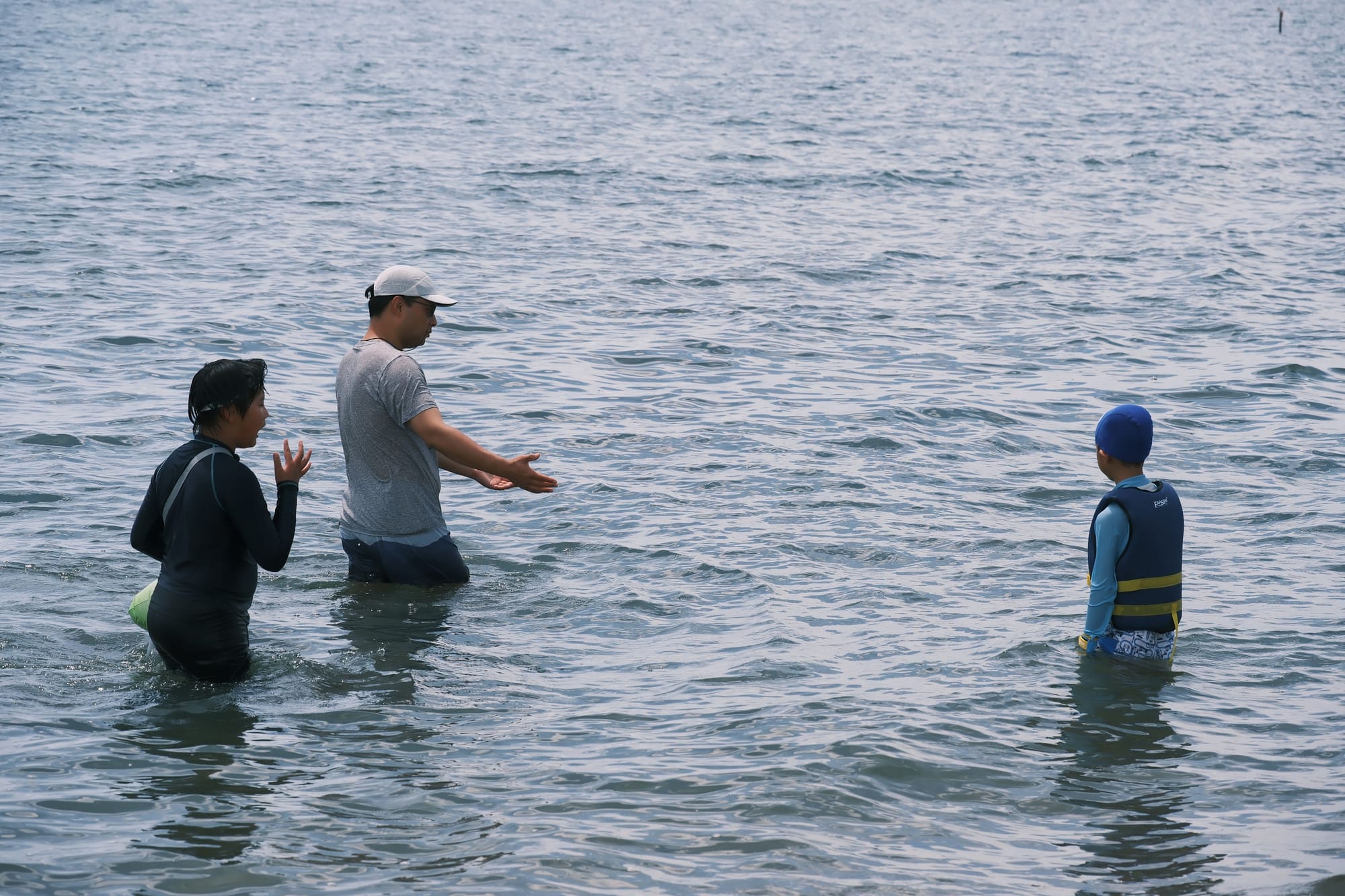
Summer vacation is finally over. Both kids are back in school. My wife and I can finally leave the house together again.
For the entire months of July and August, we ran a weekly tag-team. Monday I'd go to the office while she stayed home; Tuesday she'd go out while I covered. No nanny, no grandparents on hand. Just the two of us managing two kids, one in swimming classes, the other in cram school, with park trips, library visits, and playdates squeezed in between. Some Tuesdays I'd barely finish dropping the older one at swimming before rushing the younger one to the supermarket, then back to pick up the first kid, cook lunch, and supervise two sets of summer homework in the afternoon. Before my wife left for work, she'd rattle off a list: the swimming gear is by the door, the homework notebooks are on the table, dinner is already in the fridge. I'd often realize she was gone only when I found myself standing at the kitchen sink, washing breakfast dishes.
ChatGPT can write code, analyze financial reports, and generate images. But cooking meals, hanging laundry, playing with kids, checking homework, and tutoring English? Not a chance. When you're parenting full-time, you barely touch your phone from morning till night, let alone delegate tasks to AI. There were days when I had a splitting headache and still had to get up early, make breakfast, shuttle kids to activities, pick them up in the afternoon, and put them to bed at night. AI didn't relieve a single symptom. It couldn't even offer a "drink more water." It simply wasn't there.
Bill Gates recently published a long piece on the AI transition that gained traction both overseas and in China.
The turbulent AI era is here. The choices we make now are critical.
He said "this time is different." For the first time, AI can replace cognitive labor, reshaping the world within a decade, not generations. Gates contrasted this with the PC revolution, which took nearly 20 years to transform how we work because software had to be built, prices had to drop, and people had to learn. AI is different. It runs on devices we already own, and we interact with it in natural language. It doesn't require us to adapt to it; it adapts to us.
Gates is focused on AI replacing workers: coders, analysts, translators, designers. I'm focused on what it can't replace. Because in my kitchen that Tuesday morning, while I was washing breakfast dishes with a headache, no AI was going to step in and take over. Not because the technology isn't good enough. Because parenting isn't a job you hand off.
In the article, Gates outlines three major risks.
First, massive job displacement, especially at entry and mid-levels, hitting young people hardest.
Second, AI being exploited by bad actors: scams, disinformation, bioterrorism.
Third, stunted child development, because AI companions are too tempting. Always available, never annoyed, infinitely more patient than any human. Gates even cited Jonathan Haidt's "The Anxious Generation," calling AI companions a "large protective greenhouse." Children won't learn rejection, exclusion, or conflict resolution from AI. Those lessons only come from grinding through real relationships.
Gates also introduced the concept of "Human Reserved," zones where AI should not be allowed to tread. He went so far as to say that a robot delivering a terminal diagnosis, while technically feasible, should never happen.
But Gates himself admitted he doesn't know how to draw those boundaries. Who decides? What criteria? How do we stop companies from quietly replacing workers with robots? He raised the questions. He didn't have the answers.
My summer vacation provided some.
You don't need policy to define a Human Reserved zone. It's already here. For two months, AI didn't hang a single load of laundry for me. It didn't accompany my kids to the park when I was too exhausted. It didn't ease my symptoms when I was running a fever. This isn't about "being replaced by AI." It's about AI being unable to help with these things. Hanging laundry, cooking dinner, walking kids to the playground. Nobody wants to replace these, and nobody could. Their value isn't in "getting them done." It's in being present. When my wife leaves for work, she knows a real person is with our children. When the kids want a bedtime story, they don't want AI to read it. They want Dad. I may not tell stories as well as an AI would, but they fall asleep halfway through, and that feeling of being trusted? AI can't replicate that.
Gates also raises what he calls the "education paradox": AI can help children learn more, but it can also cause them to learn less. I felt this deeply over the summer.
On the positive side, I used AI to analyze my kids' cram school test scores. I'd feed in every monthly exam and quiz result, and it would break down which concepts they mastered and which ones kept tripping them up. After a few rounds, the AI identified that my daughter kept making careless errors in fraction calculations, while my son kept misreading word problems. Not because he couldn't solve them, but because he missed what the question was actually asking. Before each monthly exam, I'd have it generate targeted review suggestions based on the error patterns: three fraction problems today, two word problems tomorrow. I also used Codex to create separate English study plans for each child. My daughter focused on vocabulary building, starting with everyday words; my son worked on phonics. Different paces, individually tailored.
Later in the summer, I tried connecting them to GPT Live for oral practice. My daughter was terrified at first. "I'm scared I'll say it wrong." For the first week, I basically had to force her into it: three minutes per session, head down after every sentence. After two weeks, she was holding five-minute conversations. Short sentences, but she was speaking. I'd listen in, and the AI felt like a patient tutor. Never annoyed, never rolling its eyes, no accent. These are areas where AI genuinely helped.
But parents still need to be there. AI can generate a study plan, but the nudging, the encouragement, the pulling your daughter back when she wants to quit. That can't be outsourced. When my daughter practiced speaking, I'd sit beside her. When she got stuck, she'd glance at me. I'd nod. She'd continue. That presence, that encouragement? AI can't provide it. Not because it's incapable, but because it simply isn't in the room.
The flip side hit during the same summer. My daughter once copied the reference answers for her homework. Every answer was correct, but there wasn't a single calculation step showing her work. I asked her what 50 minus 13 was. She took a few seconds to answer. 37 times 12? She couldn't do it mentally. Behind those perfect answers, there was no thinking process at all. She still hadn't grasped what homework is actually for. It's not about getting the right answer. It's about walking through errors and repetition until the neural pathway forms. Copying answers and having AI write your homework are the same thing: skipping the process to get straight to the result. And that process is the learning.
This is exactly what Gates meant by the education paradox. AI delivers polished answers, but children may end up learning less. Copying reference answers and having AI complete assignments are the same thing. Both bypass thinking and jump straight to results.
Gates says the world isn't ready for the AI era.
Not being ready is exactly right.
Readiness itself takes time, and time is the one thing AI cannot give. Raising children, building trust, developing skills, learning social interaction, experiencing failure, facing mistakes. These all require time. They can't be accelerated or outsourced. AI knowing something and us knowing it ourselves are completely different things.
It can tell me my daughter is weak at fraction calculations, but it can't sit with her as she rewrites missed problems three times on scratch paper, pencil scratching back and forth, until that "ah" moment finally clicks. It can generate English conversations, but it can't replace the fumbling, heart-racing English she manages when called on in class. It can produce perfect answers, but it can't replace the conversation I had with my daughter after I caught her copying, where I didn't yell, I simply told her: the answer doesn't matter. What matters is how you got there.
Technological progress won't stop. Gates says within ten years, AI will transform nearly every industry. I believe him. But over those ten years, every family, every person, faces a choice: what to let AI handle, and what must remain ours.
AI will probably never help me hang laundry.
And maybe that's exactly as it should be.