
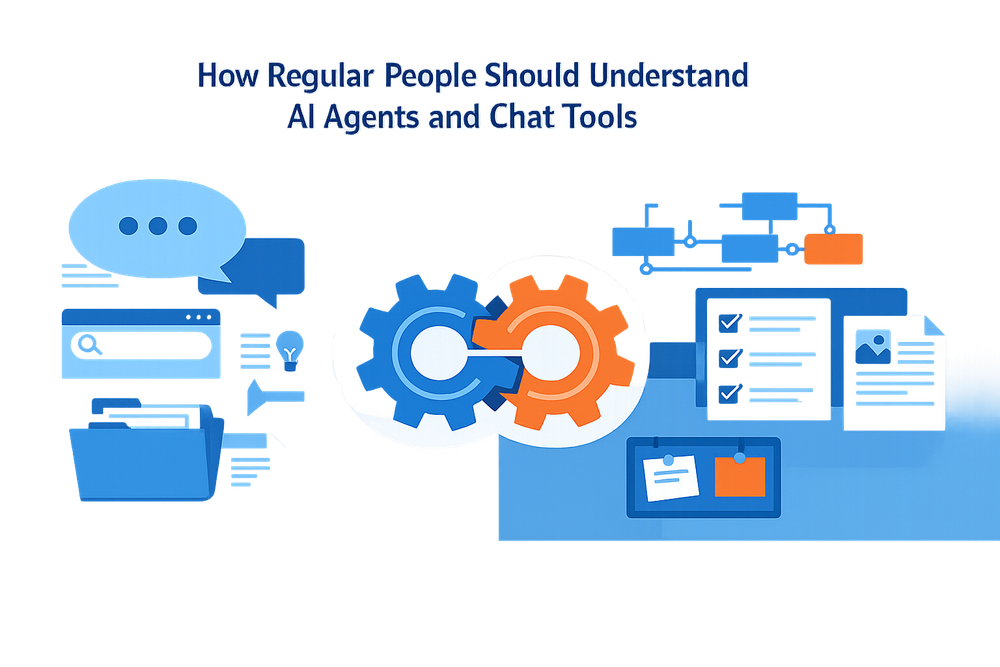
How Regular People Should Understand AI Agents and Chat Tools
One of the most common questions I get is this:
“If I already use ChatGPT, Gemini, Grok, and Perplexity, why should I also learn tools like OpenCode, Codex, or OpenClaw?”
My answer is simple: most people do not have a tool shortage. They have a role-clarity problem. Once tool roles are clear, output becomes much more stable.
Clear the relationship first, or the confusion never ends
Here is the practical split:
- ChatGPT, Gemini, Claude, Grok, and Perplexity are mostly conversation-first tools.
- OpenCode, Codex, OpenClaw, and Claude Code are mostly delivery-first agents.
This is not a replacement story. It is a division-of-labor story.
Chat tools are strong when you need to think, research, and structure ideas. Agent tools are strong when you need to break work into steps, execute repeatedly, and ship usable outputs.
A lot of frustration comes from role mismatch: people expect execution-level delivery from conversation tools, then conclude AI is overrated.
My own path: from good conversations to reliable delivery
I still use ChatGPT, Gemini, Grok, and Perplexity every day. Gemini has become more frequent in my stack because it works smoothly with Google Drive and NotebookLM, which helps a lot in writing prep, source organization, and e-commerce work.
But once I started aiming for stable delivery, that was not enough.
I needed to move from “writing one post” to “running a repeatable publishing loop,” and from “handling tasks ad hoc” to “operating with templates, process, and review.”
So my path was:
- Start with OpenCode to build execution habits.
- Shift to Codex to build a more stable writing workflow.
- Learn OpenClaw in parallel to test where it fits best.
My biggest takeaway is still: use first, optimize later.
In the AI era, barriers are lower, but real delivery does not happen automatically. You need real usage feedback before any stack can become your system.
For regular users, skip parameter wars and answer three questions
Before comparing benchmarks, answer these three.
- Are you stuck on thinking, or on finishing?
If you are stuck on thinking, go deeper on chat tools. If you are stuck on finishing, bring agents into your core flow.
- Is your core work expression-heavy or process-heavy?
If expression-heavy, let chat tools lead and agents support. If process-heavy, let agents lead and chat tools support.
- Do you have a system that can absorb outputs?
Without a material library, templates, task logs, and review loops, even a strong model gives you one-off answers.
After refreshing my own material library, this became even clearer to me: the value is not finding one more tool. The value is connecting knowledge base, skill layer, and update automation into one sustainable workflow.
A practical next step: run a 14-day closed loop
Stop collecting reviews for a moment and run one focused test.
- Choose one primary scenario: writing, e-commerce, or research organization.
- Choose one primary tool and keep it fixed.
- Fix your input/output path: input goes to your material library, output goes to a fixed drafts folder.
- Track three metrics daily: output count, rework count, and completion time.
After 14 days, your own data will tell you what matters:
- which tool actually helps you ship,
- which tool only looks good in demos,
- and which combination fits your current stage.
Do not ask which AI tool is strongest in general. Ask which setup helps you deliver consistently right now.