
The Answer Was Right. The Thinking Was Gone.
My daughter's math homework was perfect. But when I asked her to solve 50 minus 13, she froze. From elementary school to the Ivy League, thinking is disappearing.


Something happened last weekend that left me with complicated feelings.
I caught my daughter copying the answer key for her math homework.
To be honest, who among us didn't occasionally copy homework when we were kids?
But this time, it felt different.
This time it made me realize something: kids today are skipping all the learning and thinking in between, just to present a perfect-looking answer. The answers keep getting prettier, but the traces of thinking keep disappearing.
Back in the day, maybe that was fine. Everyone's calculation ability was roughly the same, so copying answers didn't matter that much.
But in today's world, I think it's a very dangerous thing to do.
I know my daughter's math level.
She's not the kind of kid who's especially good at math. Sometimes she gets stuck on homework, sometimes she needs a while to figure things out. I have a rough sense of what she can do, so when she asked me to check her homework, something felt off.
It was too smooth.
Every problem was right, but there were no calculation steps. Some problems required multiple steps, mixing addition, subtraction, multiplication, and division. You can't solve those in your head. But she wrote down only the final answers, no scratch work, no steps.
I called her over to test her.
"What's 50 minus 13?"
She thought for two seconds. "37."
I asked again: "What about 37 times 12? Can you do that in your head?"
She froze.
Not the "let me think about it" kind of freeze. The "I know I can't do this" kind of freeze.
In that moment, my feelings were complicated.
A little angry, because she copied answers.
A little disappointed, because she didn't take her learning seriously.
A little frustrated, because I knew it wasn't entirely her fault. It's on me.
I told her to redo all the problems, because I wasn't sure which ones she had copied and which ones she had done herself.
I needed her to write out all the calculation steps, even the simple ones. No more mental math.
She didn't say anything. She just took her notebook and went back to her room.
This made me think about a bigger problem.
A kid copying an answer key and a student using AI to do homework are, in practice, the same thing.
The answers are both beautiful. But do they help with thinking ability or learning ability? I'd say zero.
Once you take away the AI, or take away the answer key, the actual performance drops dramatically.
In AI education, the general consensus for younger kids is: don't give them AI.
Because general-purpose AI hides the chain of thinking and gives you a ready-made answer.
Whether it's math, language, or any other subject, the homework might look better, but it doesn't help the kid learn.
I now understand why many education experts are against giving elementary school kids AI. It's not because AI is bad. It's because if a kid starts depending on a tool to give answers before they've built basic thinking skills, those thinking skills might never get built.
A professor at Brown University ran into something similar recently.
His name is Roberto Serrano. He teaches welfare economics. This semester, he let 86 students take the midterm as a take-home exam. The average score was 96%.
96%!
That was suspiciously high. He's been teaching this course for years. The historical average is between 65% and 80%. Suddenly it jumped to 96%. Something was off.
He started looking at the students' answers and noticed many were highly similar to what ChatGPT would produce. Not exact copies, but the way they were written and the way they argued didn't look like student work.
For example, one problem asked students to prove a mathematical proposition. The most obvious approach was direct proof, but many students used proof by contradiction instead. The answer was right, but the method was strange. They'd taken a long detour.
He changed the final exam to in-person.
The result?
Only 3 students in the entire class scored close to their midterm.
Everyone else? A completely different story.
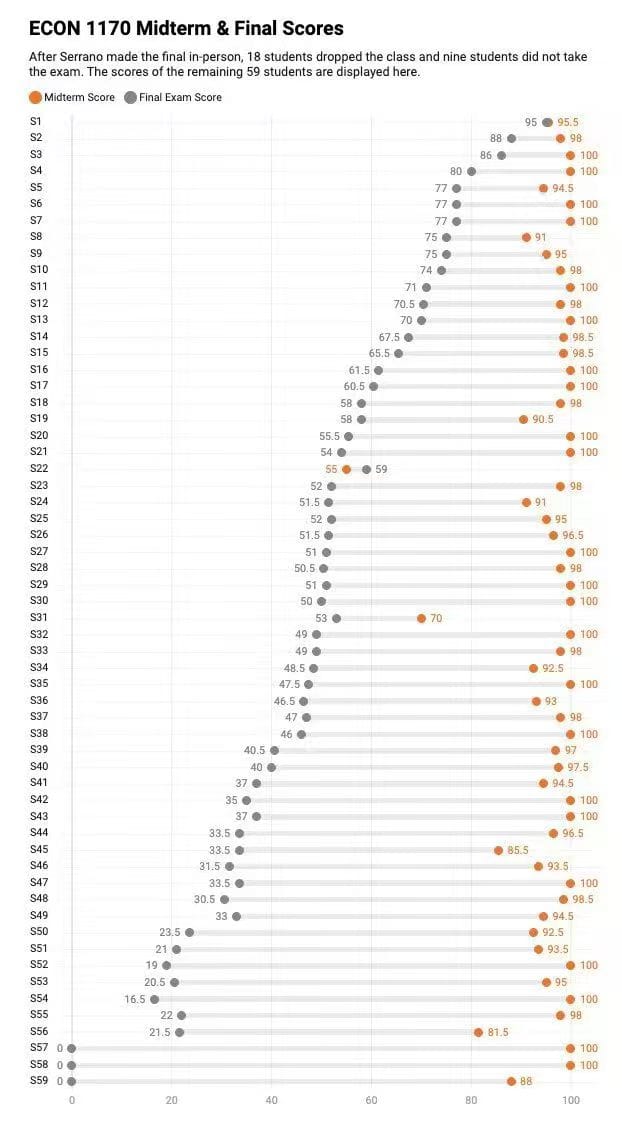
The final exam average dropped to 48.6%, the lowest in history. 18 students dropped the course, 9 didn't show up for the exam, and 19 failed.
Professor Serrano said one thing:
"We cannot choose to become idiots."
From elementary school to the Ivy League, everyone is copying answers.
The tool just changed.
This made me think about an even deeper question.
Tools have always driven progress.
Tractors replaced human labor in farming. Calculators replaced manual calculation. Computers replaced typewriters. Every new tool freed people from repetitive work and gave them more time for creative things.
But all these tools replaced physical labor or repetitive tasks, not thinking itself.
Tools are still tools. No tool before this one has ever been able to replace human thinking.
You can use a calculator to solve math problems, but you still need to know what to calculate and how to set it up.
You can use a computer to write an essay, but you still need to know what to write and how to argue it.
The tool handles execution. The human handles thinking and decision-making.
The AI era might be the first time we've encountered something different.
When AI doesn't just calculate for you, but thinks for you.
When AI doesn't just execute commands, but generates the answer directly.
When you don't even need to figure out "what to think" on your own, human thinking itself gets replaced by a tool.
This is a completely new situation.
When human thinking itself gets replaced by a tool, what happens next?
I don't know the answer.
But I think this question might be more urgent than we realize.